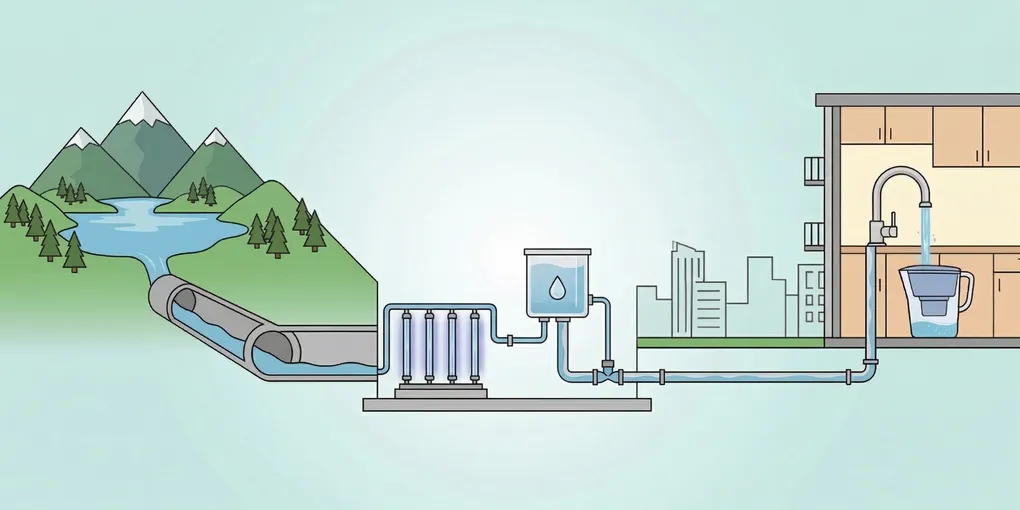
In NYC, we are lucky that our tap water is one of the cleanest in the country.
Most of it flows unfiltered from the Catskill and Delaware watersheds, so clean the EPA granted the city a rare filtration waiver. The remaining ~9% comes from the Croton system, filtered at a plant in the Bronx.
It meets every federal and state standard.
But it also contains lead from service lines, microplastics, and disinfection byproducts.
The current limits date to 1998, and research since has linked disinfection byproducts to bladder cancer at chronic exposure levels well below current limits.
The city chlorinates to kill pathogens, but chlorine reacts with organic matter to produce trihalomethanes (TTHMs) and haloacetic acids (HAA5). In 2025, HAA5 averaged 47 ppb with samples reaching 64, against a limit of 60. TTHMs averaged 52, peaking at 81, against a limit of 80.
On the upside, PFAS (“forever chemicals”) are non-detectable in the main Catskill/Delaware supply and among the lowest levels of any major U.S. city. The Croton system has shown low-level detections, but well below both state (10 ppt) and federal (4 ppt) limits.
Small living spaces are another charm of the city. A countertop filter is usually the easiest way to get started, and most people reach for the standard Brita.
It improves taste but is more cosmetic than protective. It comes down to what’s inside the filter. Different media, different ceilings.
Granular activated carbon: Brita Standard, PUR, most commodity pitchers. Loose carbon granules. Water channels through the path of least resistance, bypassing most of the media. Handles chlorine taste and odor. Does not handle lead, microplastics, disinfection byproducts, PFAS, or fluoride.
Structured carbon: Brita Elite. Carbon held in a pleated fibrous matrix with better contact time than loose granules. Removes lead, microplastics, and some PFAS. Still does not remove trihalomethanes, haloacetic acids, fluoride, or arsenic.
Carbon block + media blends: Clearly Filtered, Epic Pure. Carbon compressed into a solid block with controlled pore structure, sometimes combined with ion exchange resins. Removes everything above plus trihalomethanes, haloacetic acids, fluoride, arsenic, and PFAS.
Reverse osmosis: AquaTru, Waterdrop A1. Semipermeable membrane that rejects nearly everything except water molecules. Everything to non-detect. Tradeoffs: waste water (~20%), mineral stripping, electricity, slower throughput, and $300–500 upfront.
Safety-focused · NYC municipal water · microplastic protection & degradation
Best contaminant breadth without RO. Strong microplastic trapping when fresh — replace early (~80 gal) to stay ahead of re-release window. Nanoplastics are the gap.
Loose GAC granules have no structured pore network. Water channels through gaps — no consistent microplastic trapping from day one.
25–50% (10–20 gal)
Flow channeling worsens as granules settle. Chlorine adsorption works; particulate trapping does not — wrong mechanism for microplastics.
50–75% (20–30 gal)
Carbon sites saturating for taste/odor. No microplastic certification to degrade from — protection was never meaningful.
75–100% (30–40 gal)
Filter at capacity. Channeling risk means previously trapped particles can release. Replace at 40 gal / 2 months.
No microplastic protection at any stage. Loose granular carbon is designed for taste and odor (chlorine), not particulate removal. This is the baseline to upgrade from.
Brita Elite
0–25% (0–30 gal)
Fresh pleated carbon block at peak. Particulate Class I certified at 99.6% for 0.5–1 µm particles. Structured pore network intact.
25–50% (30–60 gal)
Strong window. Long 120-gal life means slow saturation curve. Carbon block maintains consistent contact time under gravity flow.
50–75% (60–90 gal)
Carbon adsorption sites filling. Chemical contaminants (PFAS, lead) likely declining before particulate trapping. Flow may slow.
75–100% (90–120 gal)
Same re-release dynamics as all carbon media. No usage-based indicator — timer only. Replace promptly at 120 gal or 6 months.
Similar degradation curve to other carbon blocks. The 120-gal life and Particulate I cert are real advantages over Standard. Swap by 100 gal for microplastic safety margin.
Epic Pure Dispenser
0–25% (0–25 gal / ~1 mo)
Fresh carbon block at peak. Slow gravity flow (by design) maximizes contact time. Near manufacturer’s 99.6% claim.
25–50% (25–50 gal / ~2 mo)
Good window. Epic’s deliberately slow flow maintains contact time as media loads.
50–75% (50–75 gal / ~3 mo)
Same carbon saturation dynamics. Less published data here. 90-day LED timer should trigger replacement in this window.
75–100% (75–100 gal / ~4 mo)
Re-release risk. Independent testing showed barium dropping to 41% vs. 92.7% claimed — suggesting broad performance falloff.
Honor the 90-day LED timer. 100-gal XP rating may be optimistic for microplastics. Swap at ~75 gal or 75 days, whichever first.
Clearly Filtered
0–25% (0–25 gal / ~1 mo)
Fresh media at peak. Composite + carbon pores unoccupied. Microplastic trapping near 99.99% claim.
25–50% (25–50 gal / ~2 mo)
Still strong. Sites filling but ample capacity. Flow beginning gradual decline.
50–75% (50–75 gal / ~3 mo)
Sites increasingly saturated. Chemical removal declining. Microplastic trapping likely adequate but unverified at this stage.
75–100% (75–100 gal / ~4 mo)
Critical. Peer-reviewed data: carbon filters can release accumulated particles at 75%+ capacity. Flow hits 20+ min. Replace before here.
Replace at ~80 gal (~3 mo) for microplastic safety, not the rated 100 gal. Flow slowdown is your early-warning signal. No electronic indicator — set a calendar reminder.
AquaTru Classic
0–50% (0–12 mo)
RO membrane at full effectiveness. Mechanical size exclusion — no degradation of microplastic protection. All particles ≥0.0001 µm blocked.
50–75% (12–18 mo)
Membrane stable. Flow slows as membrane fouls — but fouling actually tightens rejection. Microplastic protection improves, not degrades.
75–100% (18–24 mo)
Flow noticeably slower. Microplastic barrier intact. Replace for flow rate, not safety. Pre-filters (carbon) may saturate but sit upstream of RO.
Re-release risk
Zero. Particles rejected to wastewater, not accumulated in media. No saturation curve for microplastics.
Key insight: Only system where microplastic protection doesn’t degrade over filter life. The physics are fundamentally different from carbon adsorption.
Nanoplastic testing standards do not yet exist commercially — all nanoplastic claims are extrapolated from pore-size physics, not direct measurement.